2026
·PIANOS & STUDIES·
Steingraeber, Bayreuth, Germany
STEINGRAEBER PRESS RELEASE:
The Landscapes of Sound: An Impossible Forest
Created in collaboration with Steingraeber & Söhne, these five unique pianos form a new chapter in Antoine Wagner’s ongoing exploration of the relationship between nature, sound, memory, and myth. Conceived in Bayreuth, a city forever intertwined with the artistic legacy of Richard Wagner, the project enters into dialogue with the composer’s idea of the Gesamtkunstwerk—the total work of art in which music, image, poetry, architecture, and performance converge into a single immersive experience.
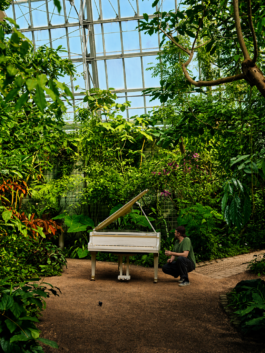
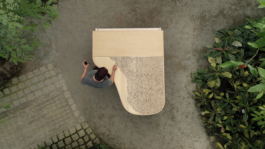
At the center of the ensemble stands a hand-painted grand piano, a symbolic landscape in itself. Its surface becomes a terrain where the elemental forces of earth, water, fire, air, and spirit meet and intertwine. The instrument reflects the profound connection between music and the natural world, echoing the way Richard Wagner transformed forests, rivers, storms, mountains, and mythological realms into emotional and sonic architectures. The piano becomes both instrument and environment, an object that invites us not only to listen, but to enter.
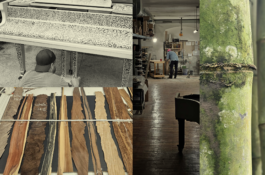
Surrounding the grand piano are four upright pianos that extend Antoine Wagner’s ongoing Impossible Forest project. Composed of woods and visual references gathered from diverse geographies, they weave together a poetic ecosystem in which cultures, species, memories, and materials coexist. Like a mythological forest that exists beyond any single place or time, these instruments suggest a world in perpetual transformation—rooted in nature yet shaped by imagination.
Throughout Antoine Wagner’s practice, the notion of the “landscape of sound” has served as a bridge between the visible and the invisible. Photography, drawing, sculpture, video, and now musical instruments become vessels through which sound can be perceived as space and nature can be experienced as music. The pianos are therefore not merely decorated objects; they are visual scores, resonant sculptures, and portals into a larger narrative.
As in Richard Wagner’s timeless works, where myth serves as a mirror for universal human experience, these instruments invite us toward the sublime. They offer a threshold between the physical and the imagined, between craftsmanship and dream, between the forest we know and the impossible forest we carry within us. Through them, music becomes landscape, landscape becomes mythology, and the act of listening becomes an act of wonder.

2026
·PIANOS & STUDIES·
Steingraeber, Bayreuth, Germany
STEINGRAEBER PRESS RELEASE:
The Landscapes of Sound: An Impossible Forest
Created in collaboration with Steingraeber & Söhne, these five unique pianos form a new chapter in Antoine Wagner’s ongoing exploration of the relationship between nature, sound, memory, and myth. Conceived in Bayreuth, a city forever intertwined with the artistic legacy of Richard Wagner, the project enters into dialogue with the composer’s idea of the Gesamtkunstwerk—the total work of art in which music, image, poetry, architecture, and performance converge into a single immersive experience.
At the center of the ensemble stands a hand-painted grand piano, a symbolic landscape in itself. Its surface becomes a terrain where the elemental forces of earth, water, fire, air, and spirit meet and intertwine. The instrument reflects the profound connection between music and the natural world, echoing the way Richard Wagner transformed forests, rivers, storms, mountains, and mythological realms into emotional and sonic architectures. The piano becomes both instrument and environment, an object that invites us not only to listen, but to enter.
Surrounding the grand piano are four upright pianos that extend Antoine Wagner’s ongoing Impossible Forest project. Composed of woods and visual references gathered from diverse geographies, they weave together a poetic ecosystem in which cultures, species, memories, and materials coexist. Like a mythological forest that exists beyond any single place or time, these instruments suggest a world in perpetual transformation—rooted in nature yet shaped by imagination.
Throughout Antoine Wagner’s practice, the notion of the “landscape of sound” has served as a bridge between the visible and the invisible. Photography, drawing, sculpture, video, and now musical instruments become vessels through which sound can be perceived as space and nature can be experienced as music. The pianos are therefore not merely decorated objects; they are visual scores, resonant sculptures, and portals into a larger narrative.
As in Richard Wagner’s timeless works, where myth serves as a mirror for universal human experience, these instruments invite us toward the sublime. They offer a threshold between the physical and the imagined, between craftsmanship and dream, between the forest we know and the impossible forest we carry within us. Through them, music becomes landscape, landscape becomes mythology, and the act of listening becomes an act of wonder.